
💪 Strength Might Be the Most Important Health Marker You’re Not Measuring
What if a simple strength test could tell you more about your long-term health than your step count… or even your running pace?
A major review published in the British Journal of Sports Medicine analysed over 150 studies (with 94 included in meta-analysis) looking at whether simple strength tests can predict future health outcomes.
🔍 The Big Idea
Across a large body of research, one consistent finding emerged:
👉 Higher strength levels are strongly associated with better long-term health outcomes.
Importantly, this is mostly observational research — so strength is best understood as a powerful marker of overall health, resilience, and function, rather than a single direct cause of these outcomes.
What it does give us is something very useful clinically:
👉 A simple, measurable window into how your body is coping with load, ageing, and activity demands.
📊 The Two Tests That Stand Out
Two very simple tests were repeatedly shown to be useful:
✔️ Grip strength
✔️ 5x sit-to-stand test (chair rises)
Better performance on these tests has been associated with lower risk of:
Cardiovascular disease
Type 2 diabetes
Functional decline and disability
Musculoskeletal problems
Reduced independence with ageing
Cognitive decline and poorer mental health outcomes
👉 In simple terms: these tests reflect overall physical robustness.
🧪 How to Test This Yourself
You don’t need a gym. These are quick, repeatable checks.
1️⃣ Sit-to-Stand Test (home version)
Sit on a standard chair
Arms crossed over chest
Stand up and sit down 5 times as quickly as possible
Time the total
👉 Faster time = better lower limb strength and functional capacity
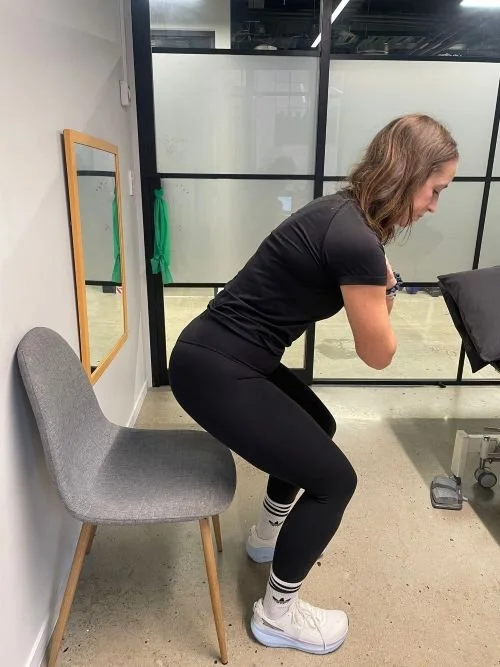
here's Allison being put to the test!
2️⃣ Grip Strength (clinic-based)
Use a hand dynamometer
Squeeze maximally for 3–5 seconds
Test both hands
Record best score
👉 We track this over time as a marker of overall strength and recovery
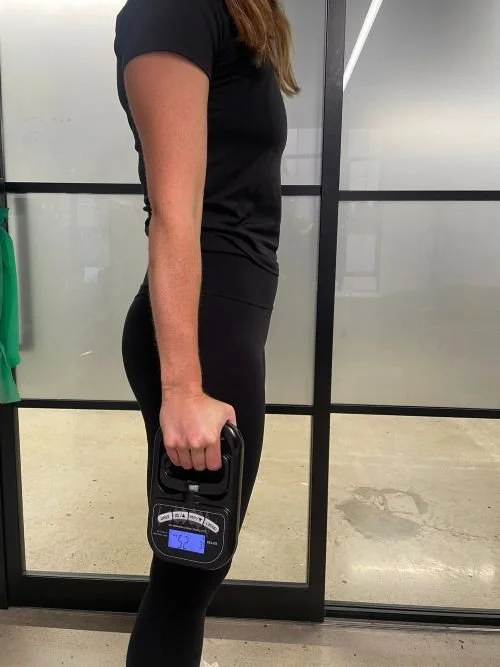
We measured each of us in the clinic
📈 What’s “Normal”? (Practical Benchmarks)
These are general reference ranges for adults. They vary with age, training background, injury history, and body size — but they are useful for self-checking and tracking change over time.
🪑 Sit-to-Stand (5 reps)
Time to complete 5 controlled stands
🟢 Good / strong baseline: < 10 seconds
🟡 Average / room to improve: 10–15 seconds
🔴 Below expected functional level: > 15 seconds
👉 Most healthy, active adults tend to sit in the green to mid-amber range.
🤝 Grip Strength
Men
🟢 Strong: 40+ kg
🟡 Average: 30–39 kg
🔴 Low: < 30 kg
Women
🟢 Strong: 30+ kg
🟡 Average: 20–29 kg
🔴 Low: < 20 kg
👉 Grip strength is one of the most widely studied “general health markers” in musculoskeletal and ageing research.
🧭 How to Interpret Your Results
Think of this less as a pass/fail test, and more as a snapshot of current capacity:
🟢 Mostly green → solid strength base and resilience
🟡 Mix of green/amber → good foundation with clear room to build
🔴 Any reds → opportunity to improve capacity (and usually very trainable)
👉 The most important signal is change over time, not a single score.
📈 What the Research Actually Means
This doesn’t mean strength is the only thing that matters.
But it does suggest:
👉 Strength reflects how well your body is functioning as a system.
It links to:
Muscle and tendon capacity
Nervous system efficiency
Balance and coordination
Ability to tolerate load (work, sport, daily life)
And importantly:
👉 Small improvements in strength are associated with meaningful improvements in long-term health outcomes.
🧭 Why This Matters Clinically
This fits strongly with what we see every day in clinic.
We’re increasingly focused on:
baseline strength markers
functional capacity (what you can actually do)
tracking improvement over time
Because:
👉 Pain levels alone don’t tell us enough
👉 Capacity tells us much more about long-term health and resilience
🏃♂️ Simple Self-Check
A quick way to reflect on your current capacity:
How easy are stairs?
Can you rise from a chair without effort?
Can you carry groceries comfortably?
Do you feel strong in day-to-day movements?
👉 If these feel harder than expected, it’s often a sign that strength and capacity could be improved.
🏥 How We Use This in Clinic
We now routinely use simple strength measures as part of assessment and rehab, to:
identify early strength deficits
guide targeted exercise prescription
track objective progress over time
support return-to-sport and long-term health goals
🏁 Bottom Line
👉 Strength is one of the most useful and under-measured health markers we have
👉 It reflects how well your body is functioning and coping with load
👉 And importantly — it is highly trainable at almost any age
