
Guest Blog by our running expert Paul White
The Home-Gym Paradox: Finding “Max Load” Without the Gym Membership
Written by physiotherapist and running assessment specialist Paul White
When we talk about building resilient runners, we often talk about load.
Not just movement for the sake of movement — but meaningful loading strong enough to stimulate adaptation in muscles, tendons, and the nervous system.
Early in my physiotherapy career, I assumed heavy loading belonged almost exclusively in the gym. If you didn’t have a squat rack, a barbell, and a stack of weight plates, I thought you were limited in how effectively you could prepare the body for the demands of running.
Over time, that perspective changed.
The body does not particularly care whether force comes from a barbell, a machine, or another external setup. What matters is whether the system experiences enough tension and effort to trigger adaptation.
That becomes particularly relevant for runners trying to rehab or strength train at home.
A lot of home programs unintentionally drift toward endless low-load repetitions that never quite prepare the body for the high-force demands of running. But with the right setup, it is possible to create a significant loading stimulus without traditional gym equipment.
One surprisingly effective option is the humble doorway pull-up bar.
The Concept: Overcoming Isometrics
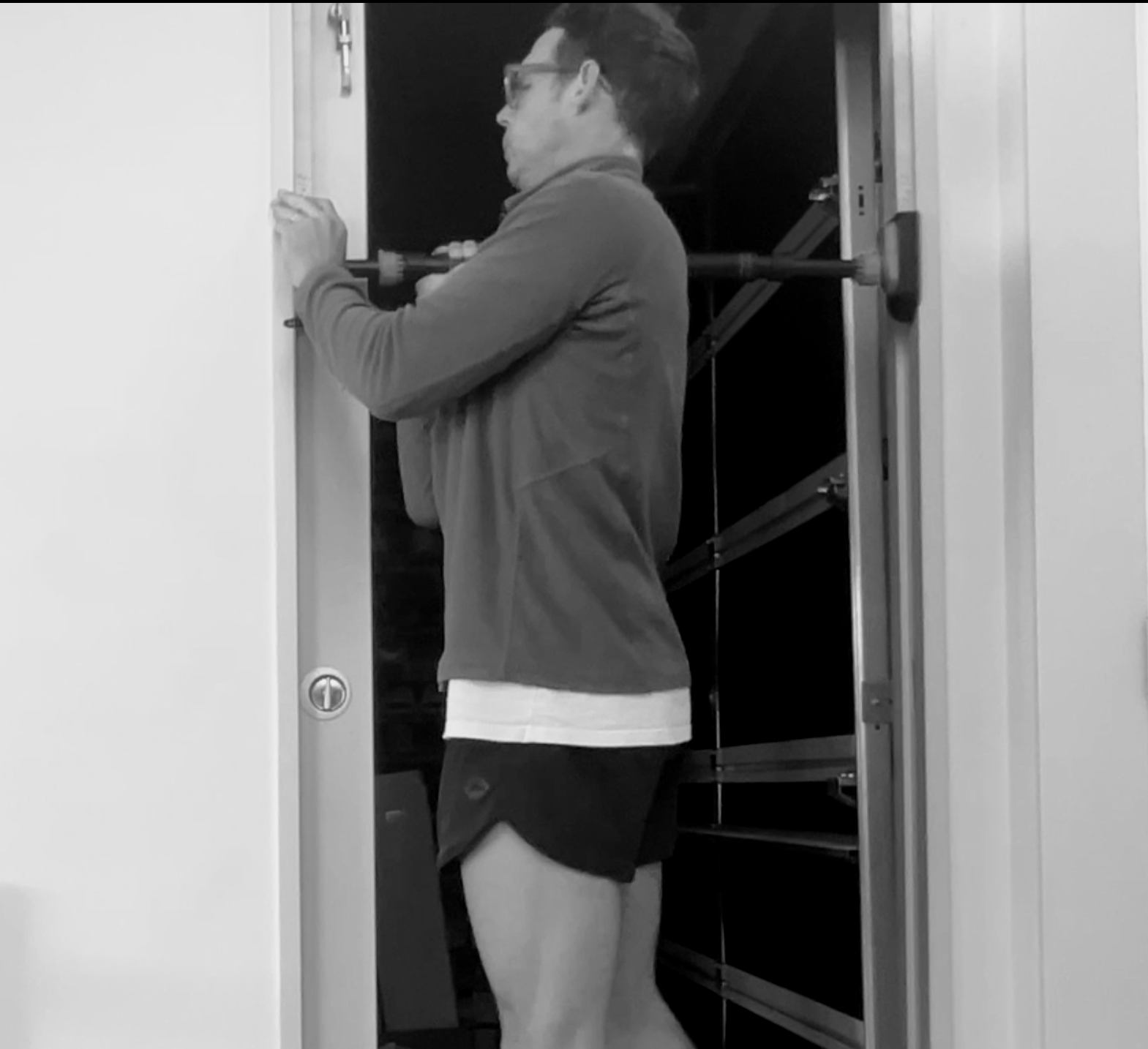
Instead of using a pull-up bar to hang from, imagine using it as an immovable resistance point.
By locking the bar securely into the doorway at an appropriate height, you can push against something that will not move.
This is known as an overcoming isometric.
In simple terms, the goal is to produce force against an immovable object, allowing you to generate a very high muscular effort without visible movement occurring.
Because the object does not move, you can often achieve a high-intensity stimulus with minimal equipment.
Here is a video guide on setting up a pull up bar at home specifically for this purpose
Why Single-Leg Loading Matters for Runners
Running is essentially a repeated sequence of single-leg landings and propulsion phases.
Every stride requires the body to:
absorb load
stabilize rapidly
produce force efficiently
transition energy through one leg at a time
For that reason, single-leg strength capacity is often highly relevant in running rehabilitation and performance.
Single-leg loading strategies may help improve:
lower limb control
tendon load tolerance
force production
movement confidence
running economy
This does not mean bilateral strength work is unimportant, but it does highlight why single-leg loading often becomes a major focus in runners.
What Are We Trying to Adapt?
Connective Tissue Loading
Tendons respond to appropriately dosed mechanical loading.
Structures such as the Achilles tendon are exposed to very large forces during running, particularly during faster running and hill work.
Higher-load isometric work may help stimulate adaptations related to tendon stiffness, force transmission, and load tolerance.
For runners recovering from overload injuries, this can become an important part of rebuilding tissue capacity.
Neuromuscular Recruitment
Maximal or near-maximal effort tasks also challenge the nervous system.
High-force isometrics may improve high-threshold motor unit recruitment and the body’s ability to produce force efficiently.
In practical terms, this may contribute to improved strength expression and running efficiency.
Two Practical Examples
I’ve attached videos below showing setup and execution examples.
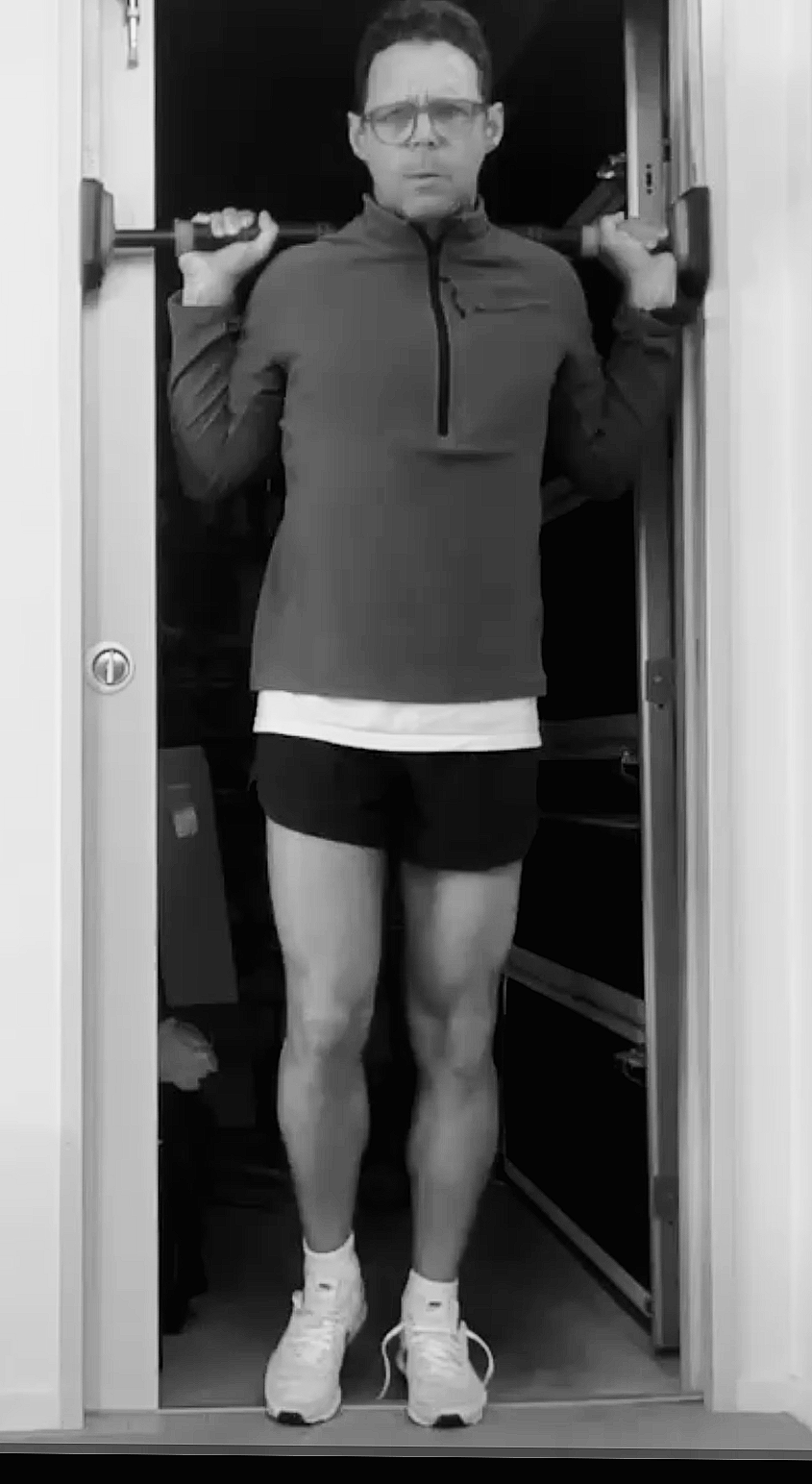
1. Single-Leg Isometric Calf Raise
Setup
Position yourself under the securely fixed bar so the bar contacts across the hips or shoulders, depending on setup height.
Stand on one leg in a calf raise position.
Action
Drive upward through the ball of the foot into maximal or near-maximal effort against the immovable bar.
Why It Can Be Useful
The calf complex — particularly the soleus — experiences substantial loading demands during running.
This setup can create a strong loading stimulus for the calf-Achilles complex without requiring heavy gym equipment.
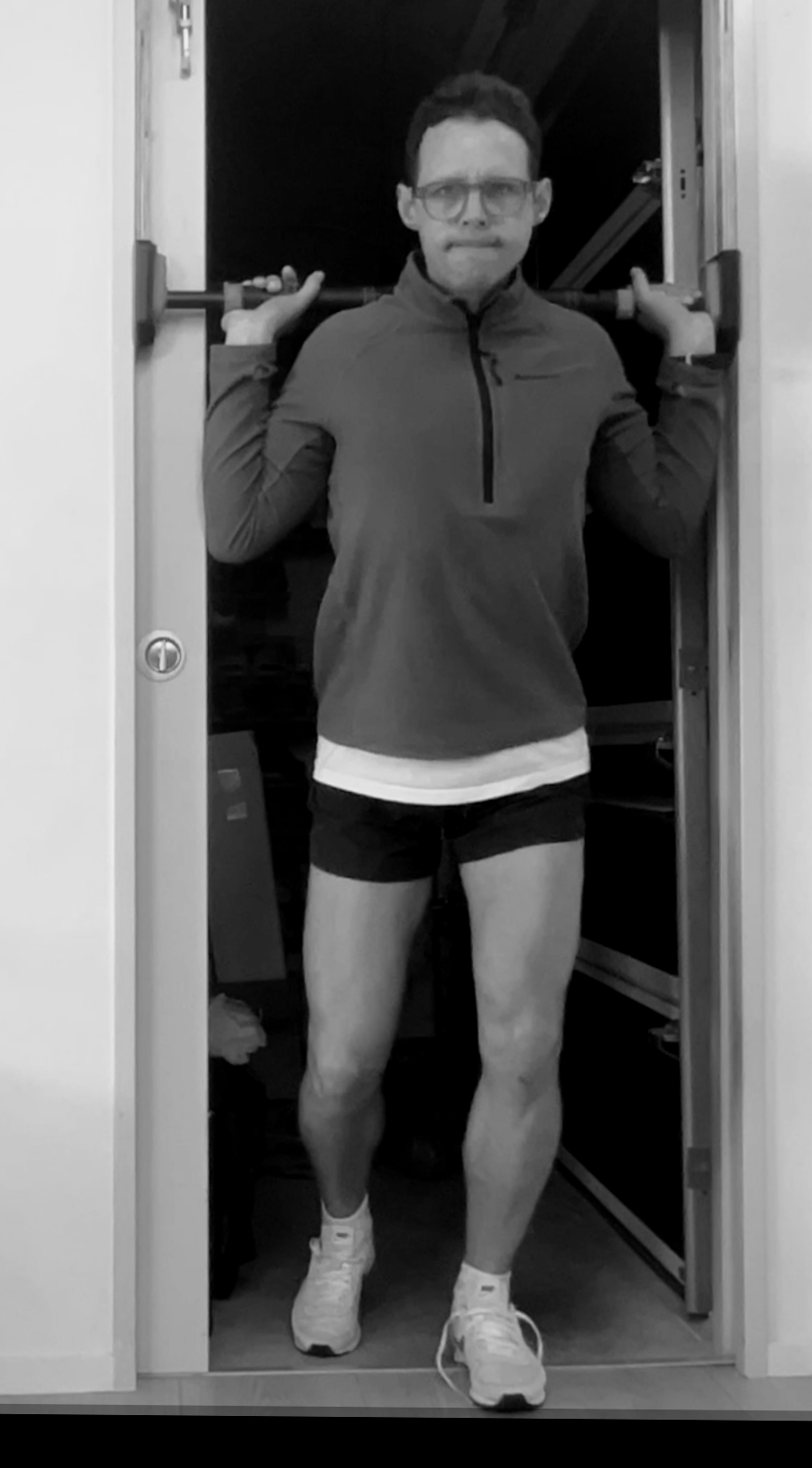
2. Single-Leg Isometric Squat
Setup
Position yourself in a mid-range single-leg squat stance beneath the bar.
Action
Press upward through the foot as though attempting to stand up against the bar.
Why It Can Be Useful
This can provide a high-force stimulus for the quadriceps, gluteal muscles, and supporting stabilizers around the hip and knee.
It may also help improve tolerance to higher loading positions commonly involved in running.
Important Considerations
These exercises create a high-intensity stimulus and should be approached thoughtfully.
A few key principles:
Build tension progressively rather than aggressively exploding into the effort.
Maximal effort is not appropriate for every injury stage.
Pain that significantly escalates during or after loading is generally a sign the dosage needs adjusting.
Technique and setup safety matter.
Consistency tends to matter more than chasing extreme effort.
As with all rehab and strength work, the goal is not to smash the system into adaptation.
The goal is to provide a stimulus the body can recover from and progressively build upon.
Final Thoughts
Gym access can absolutely be useful.
But runners without access to heavy equipment are not automatically excluded from meaningful strength adaptation.
Sometimes the limiting factor is not equipment — it is understanding how to create enough challenge.
Smartly applied isometric loading can be one useful tool within a broader rehabilitation and strength framework.
If you are unsure whether this style of loading is appropriate for your current injury or training stage, a tailored assessment and progression plan is recommended.
Train smart, and run strong.
About Paul

Paul White is a physiotherapist and our running assessment specialist. He works with runners across rehabilitation, performance, and long-term load management.
