
Can You Function Without an ACL? Lessons from the Winter Olympics
Winter Olympics time
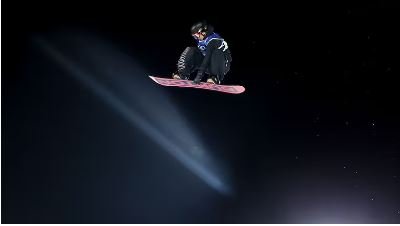
Our girl Zoi taking silver in the Big Air final — amazing!
I’ve always loved watching the Olympics — incredible athletes, stunning settings, and seeing events you don’t normally get to watch.
My wife and I were watching cross-country skiing recently, and wow — out of all the sports I’ve seen, these athletes push themselves to the absolute limit. They collapse over the finish line, completely spent. That’s the level of effort you want to see at the Olympics.
We love watching the “unusual” events too (well unusual to us)— luge, skeleton (and two person skeleton (how is that a thing), bobsled, and of course Big Air skiing and snowboarding.
Some of these events don’t even make sense to me. Take the biathlon, for example — cross-country skiing combined with shooting a gun. Alpine snipers sign up for this one…
But the level of effort I saw from Jesse Diggins — a apparently very famous cross country skier — was unlike anything I’ve seen before. She looked like she couldn’t possibly give any more. Technically it might not be the prettiest to watch, but it was gutsy, inspiring, and utterly fascinating.
Exactly what the Olympics are about
Jessie Diggins-
🏔️ Winter Olympics — and the now famous ACL
One story last week captured a lot of attention: Lindsey Vonn attempting to compete after completely rupturing her ACL.
At 41, she reportedly tore her anterior cruciate ligament just days before the Games. She trained intensively with her medical team, used a brace, and still returned to the slopes.
When that news broke, it became a topic of conversation in our clinic.
Not in a dramatic way.
More in a curious, clinical way.
“How is she managing that knee?”
“What’s providing stability?”
“How much is neuromuscular control versus bracing?”
“And what does this actually tell us about ACL function?”
Was pain management part of the equation? Almost certainly.
These are the kinds of discussions physios tend to have — slightly geeky, but genuinely fascinating to us.
Ten Days Post-ACL Rupture… and Skiing?
From a biomechanical perspective, it’s fascinating.
The ACL is an important stabiliser of the knee — particularly for rotational control — but it isn’t the only contributor to stability. Understanding this makes it a bit less surprising that she could function at all so soon after injury.
With:
Strong quadriceps and hamstrings
Excellent movement control
High-level proprioception
External bracing
Years of elite conditioning
…it becomes more understandable how someone might perform in a high-demand environment.
She would have been going into the Olympics at peak condition. Post-injury weakness may not have fully developed yet, pain was likely managed, and she is obviously mentally exceptional at pushing boundaries.
Would we recommend this approach for most people? No.
Is it biomechanically impossible? Not at all.
In our clinic, we regularly see patients:
Exercising without an ACL
Returning to running or sport without surgery
Progressing through the Cross Bracing Protocol
The body is adaptable — sometimes more than people expect.
The Crash — and the Bigger Picture
Vonn later crashed during her run, sustaining a complex tibial fracture. Reports suggest it wasn’t directly related to the ACL rupture, but rather a high-speed gate catch.
Was she unlucky? Possibly.
Was her proprioception at 100% so soon after rupture? Probably not.
Did that play a role? It’s impossible to know.
The takeaway is this: injury is rarely about one structure in isolation.
It’s load.
It’s speed.
It’s environment.
It’s fatigue.
It’s timing.
The ACL may be part of the story — but it’s rarely the whole story.
We see this often. A knee injury might sit in someone’s history, but future events are usually multifactorial rather than the result of one “weak link.”
What We Took From It
What stood out wasn’t whether she should have skied — it was how this challenges a common assumption: a ruptured ACL doesn’t automatically mean you can’t function.
Some people need surgery. Others do well with structured rehabilitation. And for some, bracing and guided loading can support healing and confidence. There isn’t one rule that fits everyone.
Our role as physios is to assess, guide, and help people make informed decisions based on evidence, goals, and individual presentation. Right now, we have patients in clinic:
Training without an ACL
Progressing confidently after rupture
Working through structured non-surgical management
And they’re doing well — because rehab is strategic, progressive, and tailored to each person’s situation.
