
"So how often should I do these... and for how long?"
I get asked this most weeks. Usually it's someone with a back that's been grumbling for months, a job that eats most of their day, and a quiet suspicion that unless they find an hour a day, there's no point.
I've always answered it with the best evidence we had, plus what we see in clinic every day. I even wrote a whole blog on it back in 2024 and landed on "at least three times a week" for strength work. Now a big new review has put firmer numbers on it, and it largely backs that up (with a twist I really like).
The review was published in the British Journal of Sports Medicine in September. Let's dig in.
First, what are we talking about?
Chronic low back pain is back pain that's hung around for more than three months. Most of the time there isn't one single structure we can point to as "the cause" (that's what "non-specific" means). That's normal. It doesn't mean something's being missed or that your back is damaged.
What we do know is that exercise is one of the most useful things you can do for it. That bit isn't new. What's been missing is the dose: how often, how long, and for how many weeks.
The all-or-nothing trap
Here's what I see a lot. People hear "exercise helps back pain" and assume more is better. So they either go hard (and flare up), or they decide they can't fit in "enough" and don't start at all.
Both are understandable. Neither is great. And as it turns out, the research doesn't really support either.
What the research found
The team behind this review (led by Nitin Arora and Daniel Belavý, with a big international group) pooled 239 randomised trials of exercise for chronic low back pain. They used a dose-response network meta-analysis, which is basically a way of comparing lots of different exercise prescriptions across lots of studies to see which amounts were linked with the biggest improvements.
In the short term (up to three months):
For day-to-day function (how much back pain gets in the way of life), the biggest gains came at about four sessions a week, 25 minutes each, over 13 weeks.
For pain, the biggest gains came at about three sessions a week, 30 minutes each, over eight weeks.
That works out at roughly two hours a week, spread across the week. Right in line with the "three times a week" we've been recommending.
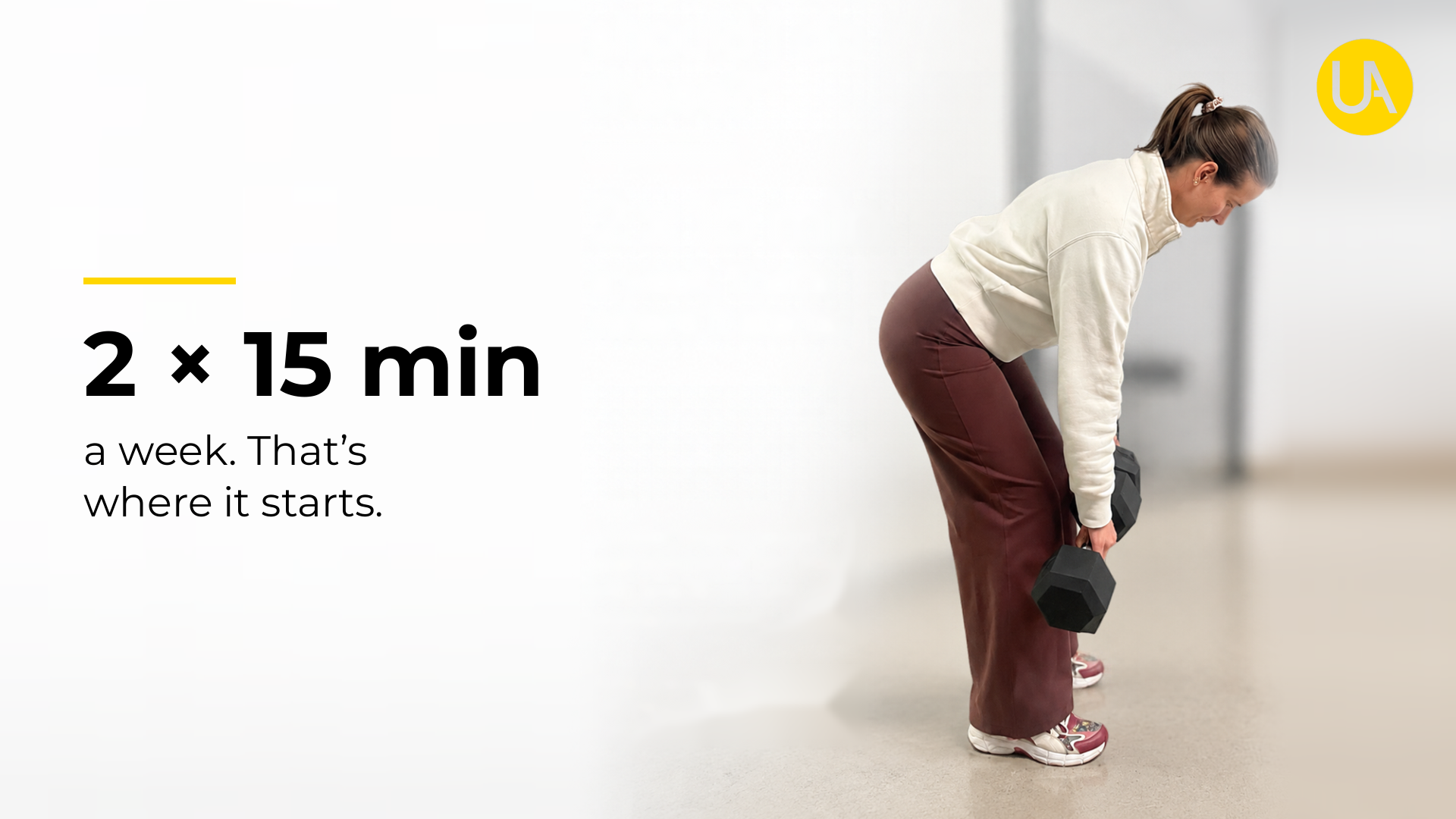
But here's the bit I really like. Meaningful improvements in function started at about two 15-minute sessions a week over six weeks. And pushing well past moderate amounts didn't add much extra in the short term.
The researchers also found a lot of overlap between doses. In plain English, there isn't one magic prescription. Lots of different amounts worked, which means we can build a programme around what you'll actually do, not a number on a page.
The fine print (and there's quite a bit)
I'd be doing you a disservice if I didn't spell this out properly.
The quality of evidence is low. Most of the trials (around 84%) had a high risk of bias, which usually comes down to how they were designed and run. The authors rate their own certainty as very low to low. So treat these numbers as guide rails, not gospel.
Each part of the dose was looked at separately. Frequency, session length and programme length were analysed one at a time, so you can't stitch the "best" of each together into a perfect recipe.
The benefits faded. Very few doses made a meaningful difference beyond three months. That's a big one (more on it below).
Sciatica wasn't really studied. Almost every trial was in back pain without nerve-related leg pain, and only two included people with leg symptoms. If your pain shoots down your leg, this research doesn't tell us much about you.
Side effects were minor. Where they were reported, they were mostly muscle and joint soreness, the kind you'd expect when starting something new.
So what does this look like in real life?
Here are a few people I see a lot (names changed... actually, no names at all).
The flat-out professional. Your back's been sore for six months, your diary is full, and your gym membership is mostly decorative. For you, two 15-minute sessions a week is a genuinely evidence-based starting point. It's not a cop-out, it's a start. Our five go-to back exercises fit nicely into 15 minutes.
The runner. You'd rather run than lie on the floor doing bridges, and that's fine. We've written about a trial where a gradual run-walk programme helped people with chronic back pain. That one was in under-45s, so if you're older, build up even more gently, but the principle stands.
The keen gym-goer. You're already doing three or four sessions a week. The message for you isn't "do more", it's "keep going". Piling on extra hours didn't add much benefit in the short term.
What I'd take from it
Start with the minimum, then build. Two 15-minute sessions a week is a legitimate place to begin. If that goes well, work towards three or four sessions, roughly two hours a week, over the following couple of months.
Pick something you'll keep doing. As I've said before, core work isn't the magic bullet. Walking, strength training, Pilates, swimming and run-walking all have a place. The best one is the one you don't dread.
Little and often beats the weekend warrior. The sweet spots were three or four sessions of 25–30 minutes a week, not one big session on a Sunday.
Expect a bit of soreness, and know what's okay. Some stiffness or aching that settles within a day is normal when you start or step things up. Pain that's sharp, builds session to session, or hangs around for days is a sign to ease back and adjust.
Plan for month four. This is the one I'd underline. The gains faded over time, which won't surprise anyone who's quietly ditched their exercises the minute their back felt better (guilty...). Exercise isn't a course of antibiotics. The habit is the treatment. There are some tips on making it stick here.
When to get it checked
Most back pain isn't dangerous, but it's worth getting assessed if:
it's new, severe or getting steadily worse
it runs down your leg, or comes with pins and needles, numbness or weakness
it wakes you at night, or you feel generally unwell with it
it isn't improving after a few weeks of sensible exercise.
Seek urgent medical care if you have any changes in bladder or bowel control, or numbness around your groin or bottom.
Bottom line
You don't need an hour a day to help a sore back. Two short sessions a week is a real, evidence-based starting point, and around two hours a week seems to be where the biggest short-term gains are. Beyond that, what matters most is finding something you'll keep doing long after the first three months.
If you'd like a hand working out where to start (and a plan for keeping it going), our UA Spine team can help.
Reference
Optimal exercise dose in adults with chronic low back pain disorders: systematic review with dose-response network meta-analysis. British Journal of Sports Medicine, 2026. doi:10.1136/bjsports-2026-111988
